Ideology & Causes -
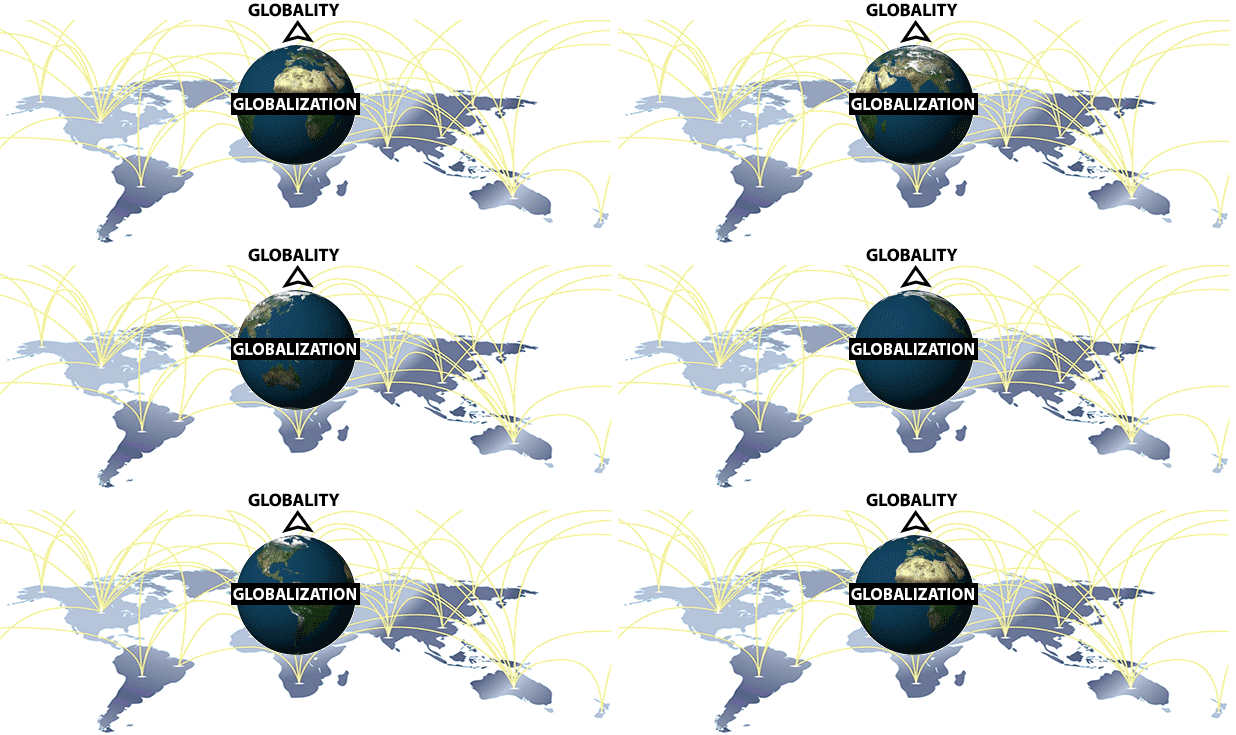
Supporters believe that by the late 20th century those they characterized as "ruling elites" sought to harness the expansion of world markets for their own interests; this combination of the Bretton Woods institutions, states, and multinational corporations has been called "globalization" or "globalization from above." In reaction, various social movements emerged to challenge their influence; these movements have been called "anti-globalization" or "globalization from below."
Poverty-
Although there has been a big decrease in the percentage of people in developing countries living below $1 per day in East Asia, some regions – notably sub-saharan Africa – has only seen a slight decrease in poverty rates. Kofi Annan responded to this criticism: "But let me hasten to add that, at present, only a relatively small number of countries are enjoying these gains. Many millions of people are excluded, left behind in squalor not because they have been exposed to too much globalization but because they have had too little or none at all.
Income disparity-
Increases in income disparity has occurred over the last 20 years. In the USA the income of the top 50% has risen to a much greater extent than the income of the bottom 50% of American citizens which has risen only slightly over the last forty years.
Opposition to international financial institutions and transnational corporations-
Generally speaking, protesters believe that the global financial institutions and agreements undermine local decision-making methods. Corporations exercise privileges that human citizens cannot:
moving freely across borders, extracting desired natural resources, and utilizing a diversity of human resources.
They are able to move on after doing permanent damage to the natural capital and biodiversity of a nation, in a manner impossible for that nation's citizens. Activists' goals are for an end to the legal status of "corporate personhood" and the dissolution of free market fundamentalism and the radical economic privatization measures of the World Bank, International Monetary Fund, and World Trade Organization.
The activists are especially opposed to "globalization abuse" and the international institutions that promote neoliberalism without regard to ethical standards. Common targets include the World Bank (WB), International Monetary Fund (IMF), the Organisation for Economic Co-operation and Development (OECD) and the World Trade Organization (WTO) and free trade treaties like theNorth American Free Trade Agreement (NAFTA), Free Trade Area of the Americas (FTAA), the Multilateral Agreement on Investment (MAI) and the General Agreement on Trade in Services(GATS). In light of the economic gap between rich and poor countries, movement adherents claim “free trade” without measures in place to protect the environment and the health and well being of workers will contribute only to the strengthening the power of industrialized nations (often termed the "North" in opposition to the developing world's "South".
It is often argued that the United States has a special advantage in the global economy because ofdollar hegemony, and that dollar dominance is not just a consequence of US economic superiority. Globalization historians claim that dollar dominance has been achieved also by political agreements such as the Bretton Woods System and OPEC dollar-only petroleum trade after the US broke with the gold standard for the dollar.
Global opposition to neoliberalism-
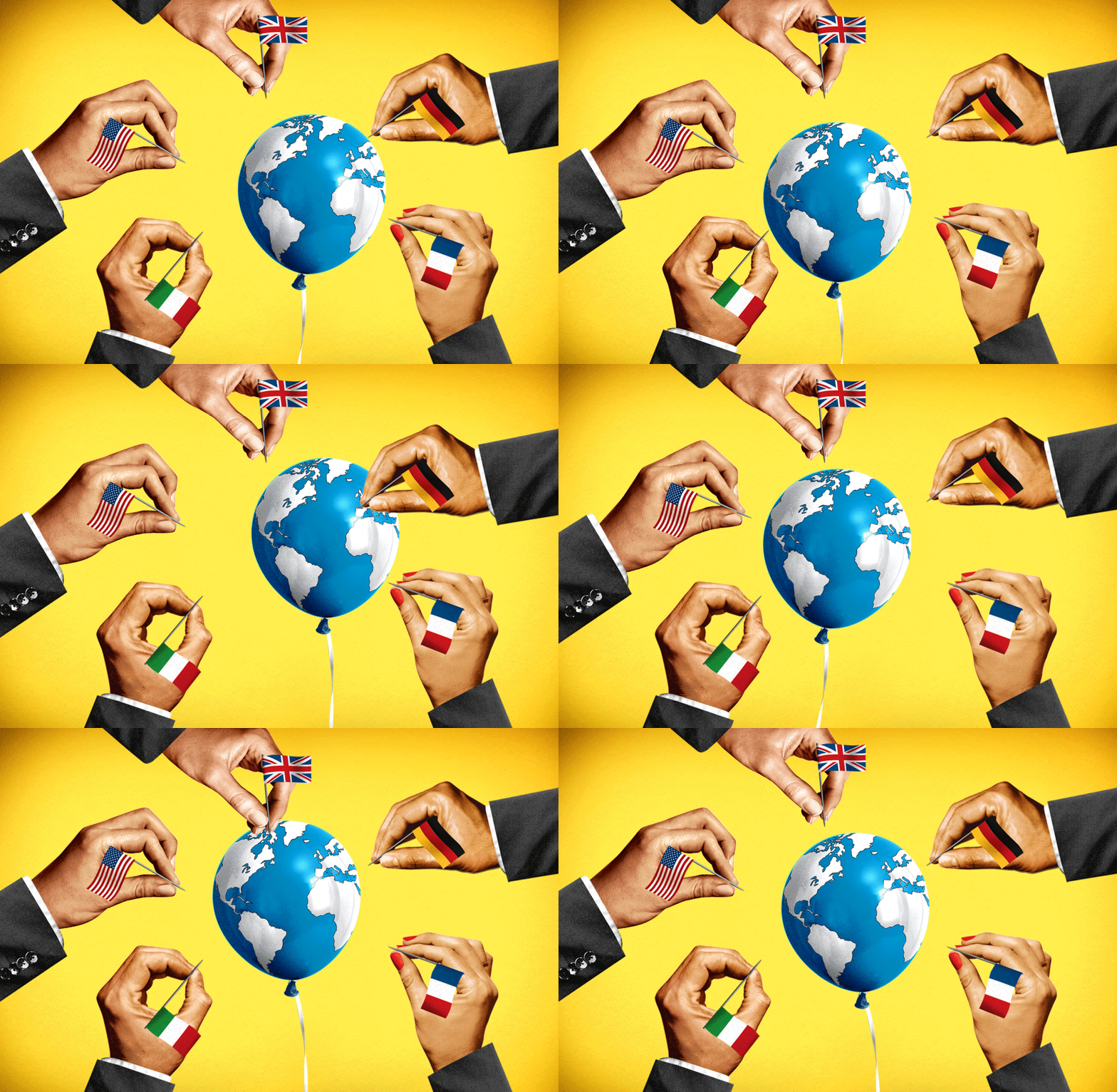
Through the Internet, a worldwide movement began to develop in opposition to the doctrines of neoliberalism which were manifested on a global scale in the 1990s when the Organisation for Economic Co-operation and Development (OECD) proposed liberalisation of cross-border investment and trade restrictions through its Multilateral Agreement on Investment (MAI). This treaty was prematurely exposed to public scrutiny and subsequently abandoned in November 1998 in the face of strenuous protest and criticism by national and international civil society representatives.
Neoliberal doctrine argued that untrammeled free trade and reduction of public-sector regulation would bring benefits to poor countries and to disadvantaged people in rich countries. Anti-globalization advocates urge that preservation of the natural environment, human rights (especially workplace rights and conditions) and democratic institutions are likely to be placed at undue risk by globalization unless mandatory standards are attached to liberalisation. Noam Chomsky stated in 2002 that
The term "globalization" has been appropriated by the powerful to refer to a specific form of international economic integration, one based on investor rights, with the interests of people incidental. That is why the business press, in its more honest moments, refers to the "free trade agreements" as "free investment agreements" (Wall St. Journal). Accordingly, advocates of other forms of globalization are described as "anti-globalization"; and some, unfortunately, even accept this term, though it is a term of propaganda that should be dismissed with ridicule. No sane person is opposed to globalization, that is, international integration. Surely not the left and the workers movements, which were founded on the principle of international solidarity—that is, globalization in a form that attends to the rights of people, not private power systems.
The dominant propaganda systems have appropriated the term "globalization" to refer to the specific version of international economic integration that they favor, which privileges the rights of investors and lenders, those of people being incidental. In accord with this usage, those who favor a different form of international integration, which privileges the rights of human beings, become "anti-globalist." This is simply vulgar propaganda, like the term "anti-Soviet" used by the most disgusting commissars to refer to dissidents. It is not only vulgar, but idiotic. Take the World Social Forum, called "anti-globalization" in the propaganda system—which happens to include the media, the educated classes, etc., with rare exceptions. The WSF is a paradigm example of globalization. It is a gathering of huge numbers of people from all over the world, from just about every corner of life one can think of, apart from the extremely narrow highly privileged elites who meet at the competing World Economic Forum, and are called "pro-globalization" by the propaganda system. An observer watching this farce from Mars would collapse in hysterical laughter at the antics of the educated classes.
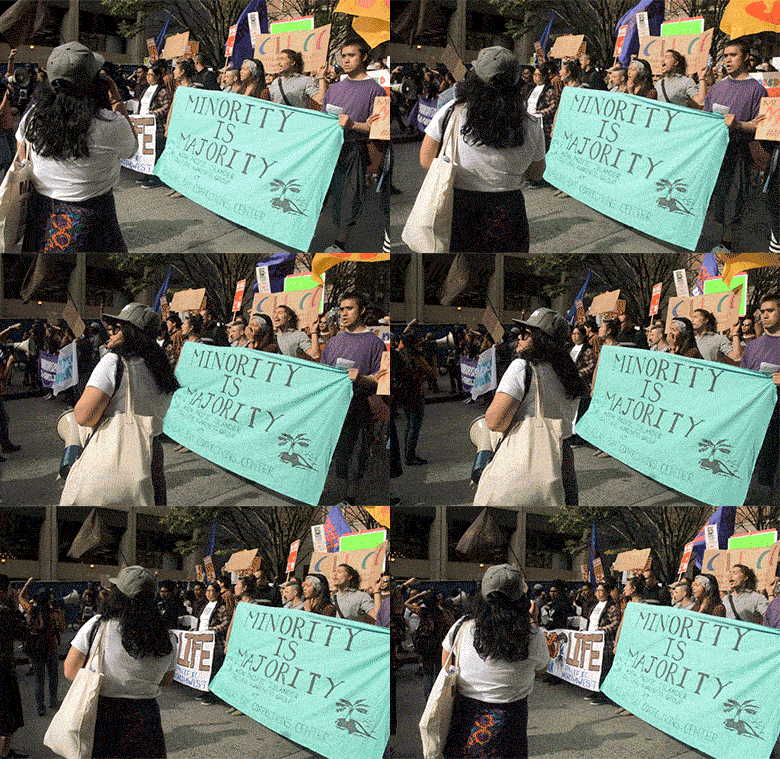
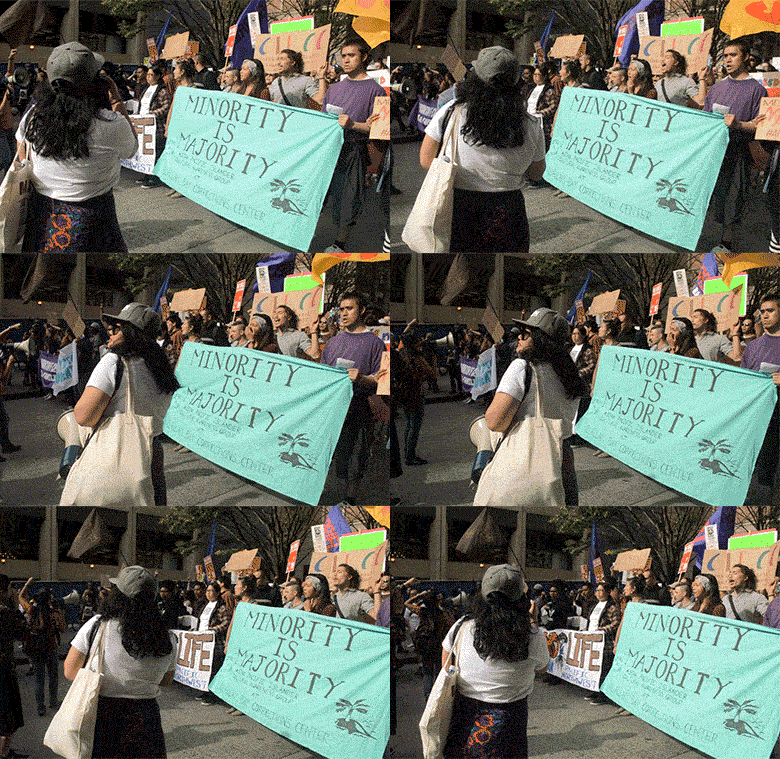
Anti-war movement-
By 2002, many parts of the movement showed wide opposition to the impending invasion of Iraq. Many participants were among those 11 million or more protesters that on the weekend of February 15, 2003, participated in global protests against the imminent Iraq war and were dubbed the "world's second superpower" by an editorial in the New York Times. Other anti-war appointments wereorganized by the anti globalization movement as such: see for example the big demonstration against the impending war in Iraq that closed the first European Social Forum on November 2002 in Florence, Italy.
Anti-globalization militants worried for a proper functioning of democratic institutions as the leaders of many democratic countries (Spain,Italy, Poland and the United Kingdom) were acting against the wishes of the majorities of their populations in supporting the war. Chomsky asserted that these leaders "showed their contempt for democracy". Critics of this type of argument have tended to point out that this is just a standard criticism of representative democracy — a democratically elected government will not always act in the direction of greatest current public support — and that, therefore, there is no inconsistency in the leaders' positions given that these countries are parliamentary democracies.
The economic and military issues are closely linked in the eyes of many within the movement.
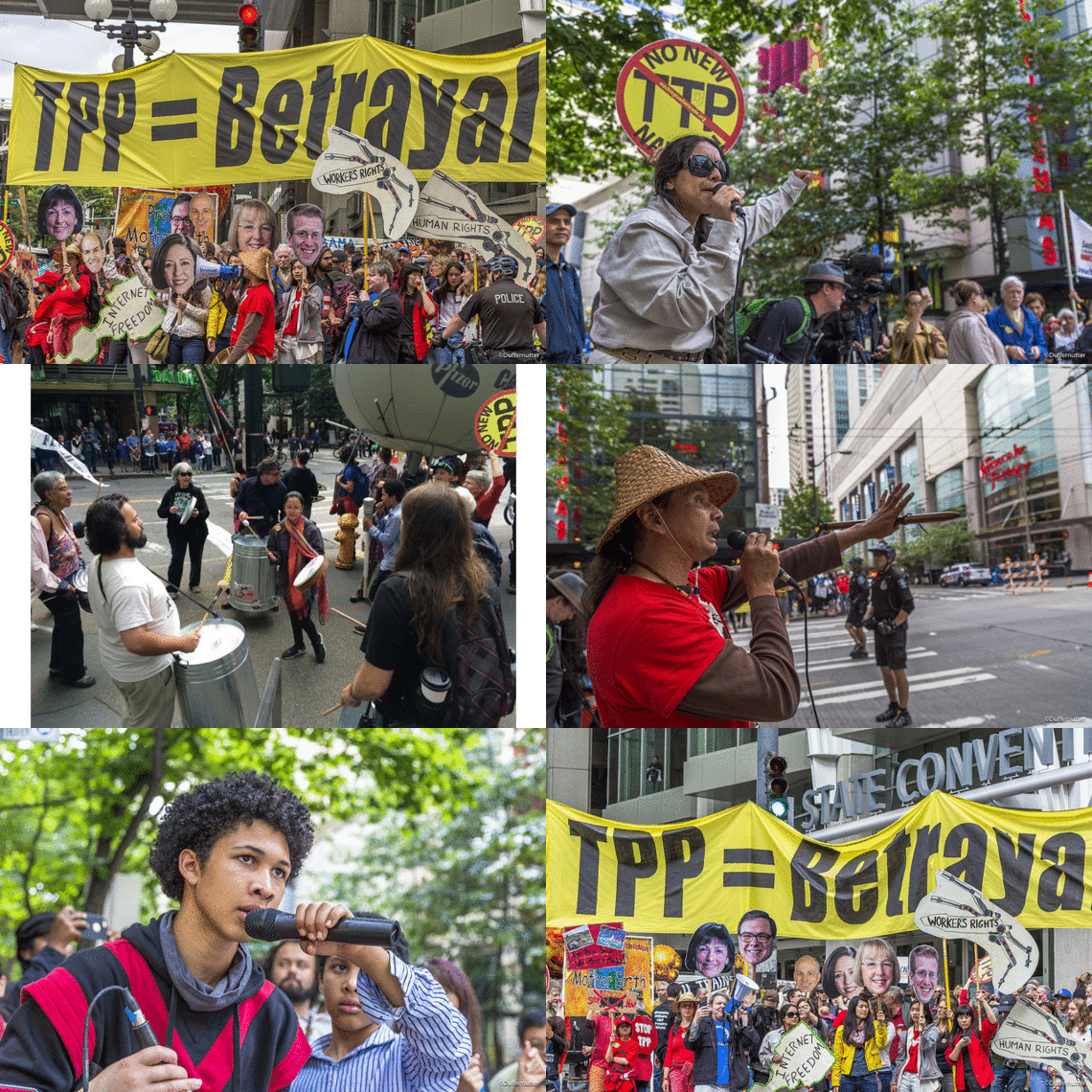
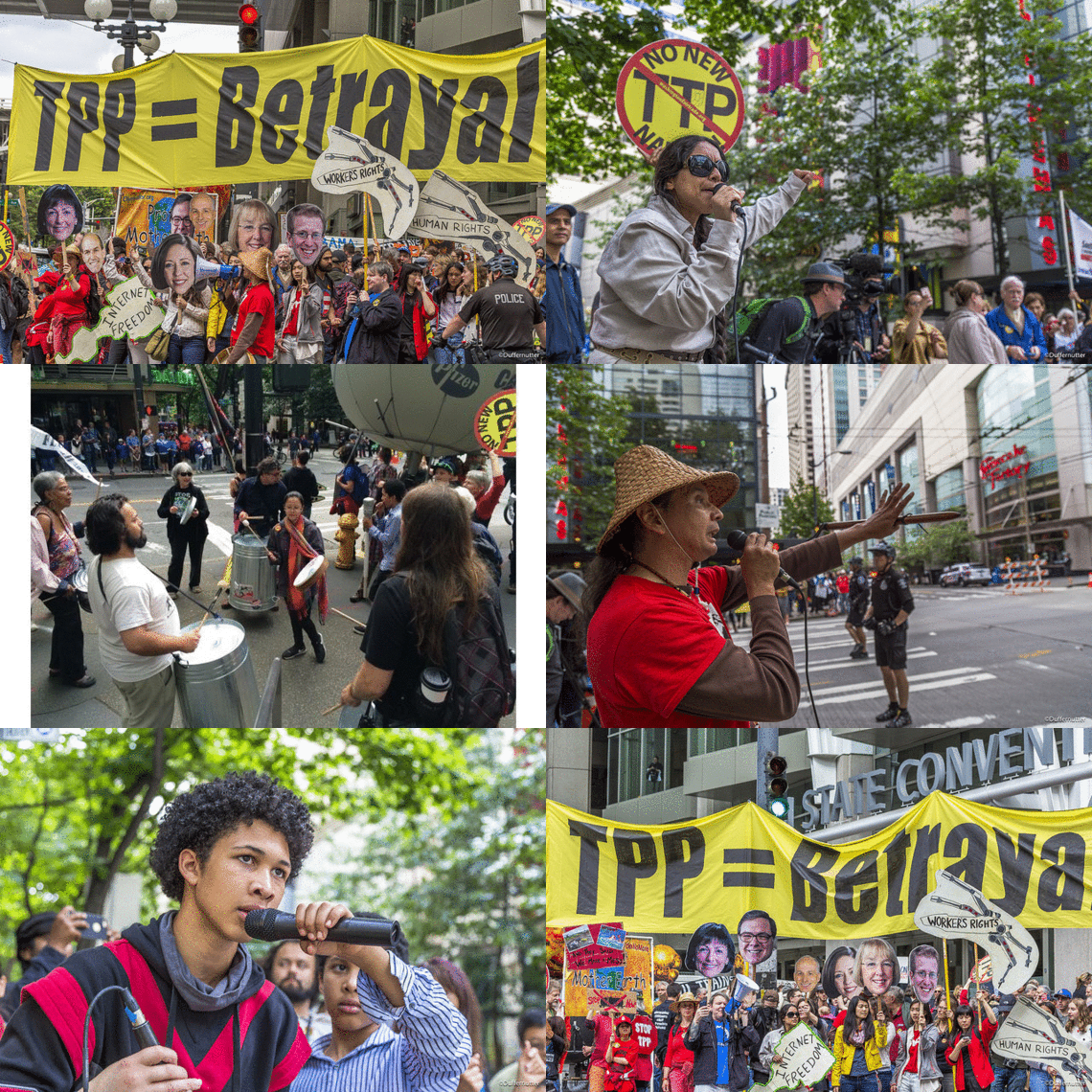
Appropriateness of the term-
Many participants (see Noam Chomsky's quotes above) consider the term "anti-globalization" to be a misnomer. The term suggests that its followers support protectionism and/or nationalism, which is not always the case - in fact, some supporters of anti-globalization are strong opponents of both nationalism and protectionism: for example, the No Border network argues for unrestricted migration and the abolition of all national border controls. S A Hosseini (an Australian sociologist and expert in global social movement studies), argues that the term anti-globalization can be ideal-typically used only to refer to only one ideological vision he detects alongside three other visions (the anti-globalist, the alter-globalist and the alter-globalization). He argues that the three latter ideal-typical visions can be categorized under the title of global justice movement. According to him, while the first two visions (the alter-globalism and the anti-globalism) represent the reconstructed forms of old and new left ideologies, respectively, in the context of current globalization, only the third one has shown the capacity to respond more effectively to the intellectual requirements of today’s global complexities. Underlying this vision is a new conception of justice, coined accommodative justice by Hosseini, a new approach towards cosmopolitanism (transversal cosmopolitanism), a new mode of activist knowledge (accommodative consciousness), and a new format of solidarity, interactive solidarity.
Two main approaches to finding a common term for the movement can be distinguished: one that might be described as "anti-globalist" or "regionalist", and another that embraces some aspects of globalization (like cross-cultural exchange of information or the diminishing role of the nation-state) while rejecting others (like neo-liberal economics). While proponents of both approaches often cooperate and are a reaction to the same phenomena, their differences might be actually greater than the common ground. The former approach can be described as outright anti-globalist (usually including what is perceived as "Americanization" of culture), while the latter would be more appropriately called "globalization critics". In practice, however, there is no set boundary between these approaches, and the term "anti-globalization" is often indiscriminately applied.
The global justice movement describes the loose collection of individuals and groups—often referred to as a “movement of movements”, which advocate fair trade rules and are critical of current institutions of global economics such as the World Trade Organization. The movement is often labelled the anti-globalization movement by the mainstream media. Those involved, however, frequently deny that they are “anti-globalization,” insisting that they support the globalization of communication and people and oppose only the global expansion of corporate power. The term further indicates an anti-capitalist and universalist perspective on globalization, distinguishing the movement from those opponents of globalization whose politics are based on a conservative defence of national sovereignty. Participants include student groups,NGOs, trade unions, faith-based and peace groups throughout the world. However it is clear that the movement is overwhelmingly dominated by Northern Hemisphere NGOs and that there is a systemic marginalisation of popular organisations from the global South.


Influences-
Several influential critical works have inspired the anti-globalization movement. No Logo, the book by the Canadian journalist Naomi Klein who criticized the production practices of multinational corporations and the omnipresence of brand-driven marketing in popular culture, has become "manifesto" of the movement, presenting in a simple way themes more accurately developed in other works. In India some intellectual references of the movement can be found in the works of Vandana Shiva, an ecologist and feminist, who in her book Biopiracy documents the way that the natural capital of indigenous peoples and ecoregions is converted into forms ofintellectual capital, which are then recognized as exclusive commercial property without sharing the private utility thus derived. The writerArundhati Roy is famous for her anti-nuclear position and her activism against India's massive hydroelectric dam project, sponsored by theWorld Bank. In France the well-known monthly paper Le Monde Diplomatique has advocated the antiglobalization cause and an editorial of its director Ignacio Ramonet brought about the foundation of the association ATTAC. Susan George of the Transnational Institute has also been a long-term influence on the movement, as the writer of books since 1986 on hunger, debt, international financial institutions and capitalism. The works of Jean Ziegler, Christopher Chase-Dunn, and Immanuel Wallerstein have detailed underdevelopment and dependence in a world ruled by the capitalist system. Pacifist and anti-imperialist traditions have strongly influenced the movement. Critics of United States foreign policy such as Noam Chomsky, Susan Sontag, and anti-globalist pranksters The Yes Men are widely accepted inside the movement.
Although they may not recognize themselves as antiglobalists and are pro-capitalism, some economists who don't share the neoliberal approach of international economic institutions have strongly influenced the movement. Amartya Sen's Development as Freedom (Nobel Prize in Economics, 1999), argues that third world development must be understood as the expansion of human capability, not simply the increase in national income per capita, and thus requires policies attuned to health and education, not simply GDP. James Tobin's (winner of theNobel Prize in Economics) proposal for a tax on financial transactions (called, after him, the Tobin Tax) has become part of the agenda of the movement.
Internet sources and free-information websites, such as Indymedia, are a means of diffusion of the movement's ideas. The vast array of material on spiritual movements, anarchism, libertarian socialism and the Green Movement that is now available on the Internet has been perhaps more influential than any printed book. The previously obscure works of Arundhati Roy, Starhawk, and John Zerzan, in particular, inspired a critique favoring feminism, consensus process and political secession.
Organization–
Although over the past years more emphasis has been given to the construction of grassroots alternatives to (capitalist) globalization, the movement's largest and most visible mode of organizing remains mass decentralized campaigns of direct action and civil disobedience. This mode of organizing, sometimes under the banner of the Peoples' Global Action network, tries to tie the many disparate causes together into one global struggle. In many ways the process of organizing matters overall can be more important to activists than the avowed goals or achievements of any component of the movement.
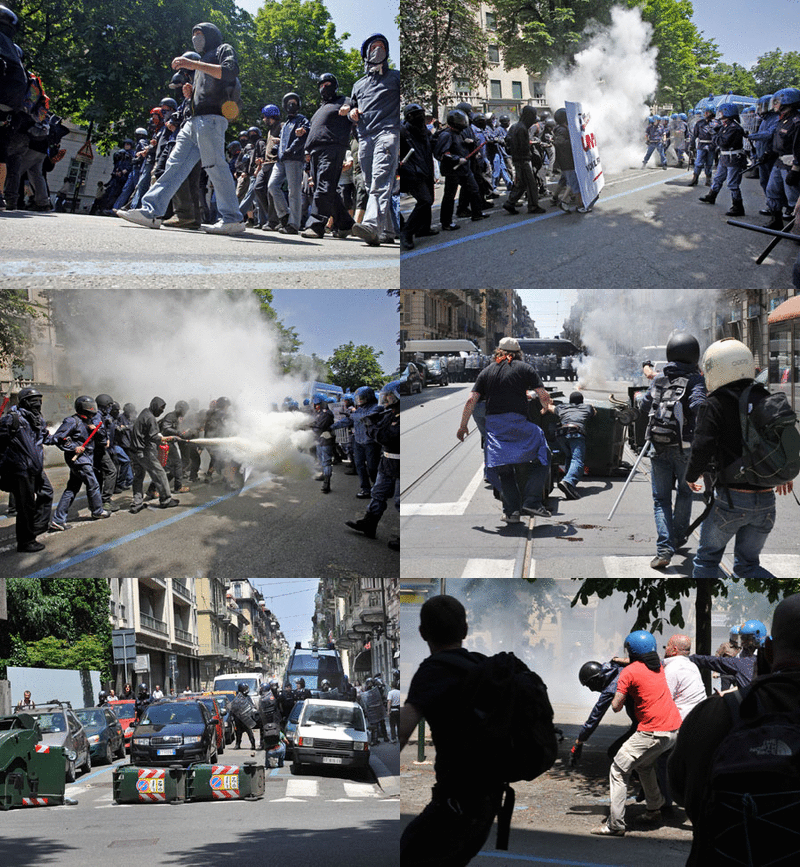
At corporate summits, the stated goal of most demonstrations is to stop the proceedings. Although the demonstrations rarely succeed in more than delaying or inconveniencing the actual summits, this motivates the mobilizations and gives them a visible, short-term purpose. Critics claim that this form of publicity is expensive in police time and the public purse. Although not supported by many] in the movement, rioting has occurred in Genoa, Seattle and London and extensive damage can be done to the area, especially corporate targets, including McDonald's and Starbucks restaurants.
Despite (or perhaps because of) the lack of formal coordinating bodies, the movement manages to successfully organize large protests on a global basis, using information technology to spread information and organize. Protesters organize themselves into "affinity groups," typically non-hierarchical groups of people who live close together and share a common political goal. Affinity groups will then send representatives to planning meetings. However, because these groups can be infiltrated by law enforcement intelligence, important plans of the protests are often not made until the last minute. One common tactic of the protests is to split up based on willingness to break the law. This is designed, with varying success, to protect the risk-averse from the physical and legal dangers posed by confrontations with law enforcement. For example, in Prague during the anti-IMF and World Bank protests in September 2000 demonstrators split into three distinct groups, approaching the conference center from three directions: one engaging in various forms of civil disobedience (the Yellow march), one (the Pink/Silver march) advancing through "tactical frivolity" (costume, dance, theatre, music, and artwork), and one (the Blue march) engaging in violent conflicts with the baton-armed police, with the protesters throwing cobblestones lifted from the street. These demonstrations come to resemble small societies in themselves. Many protesters take training in first aid and act as medics to other injured protesters. In the USA, some organizations like the National Lawyer's Guild and, to a lesser extent, the American Civil Liberties Union, provide legal witnesses in case of law enforcement confrontation. Protesters often claim that major media outlets do not properly report on them; therefore, some of them created the Independent Media Center, a collective of protesters reporting on the actions as they happen.
